Paper Bag Thickness Guide: GSM, Strength & Sample Tests
Paper bag thickness is not the same thing as paper weight—and neither number alone tells you how much a finished takeaway bag can carry. When comparing kraft paper bags, buyers often see GSM figures on quotations and assume that a larger number always produces a better bag. In practice, paper grade, actual thickness, bag dimensions, bottom construction, folds and moisture exposure also matter.
This paper bag thickness guide explains how to read supplier specifications and how to test a finished sample before placing a wholesale order.
1. What does GSM mean for a paper bag?
GSM means grams per square metre (g/m²), also called paper grammage or basis weight. For example, a hypothetical 100 GSM sheet weighs approximately 100 grams over an area of one square metre, before any conversion into a bag. Actual finished bag weight also depends on the total paper area, folds, seams, printing and optional treatments.
Industry grammage measurement is described by ISO 536:2019. If two supplier offers quote different GSM figures, verify that the values refer to the same paper layer and that the full material specification is comparable.
2. GSM vs thickness vs finished-bag strength
| Specification | What it tells you | What it does not guarantee |
|---|---|---|
| GSM (g/m²) | Mass of the paper over a defined area | Exact caliper, wet strength or finished-bag load rating |
| Thickness / caliper | Measured paper thickness, often in micrometres | That the bag will carry a particular number of kilograms |
| Paper grade and fiber | Part of the material construction and performance profile | A uniform outcome without testing and quality control |
| Bag construction | Bottom folds, glued seams, size and load distribution | Moisture resistance or strength beyond tested conditions |
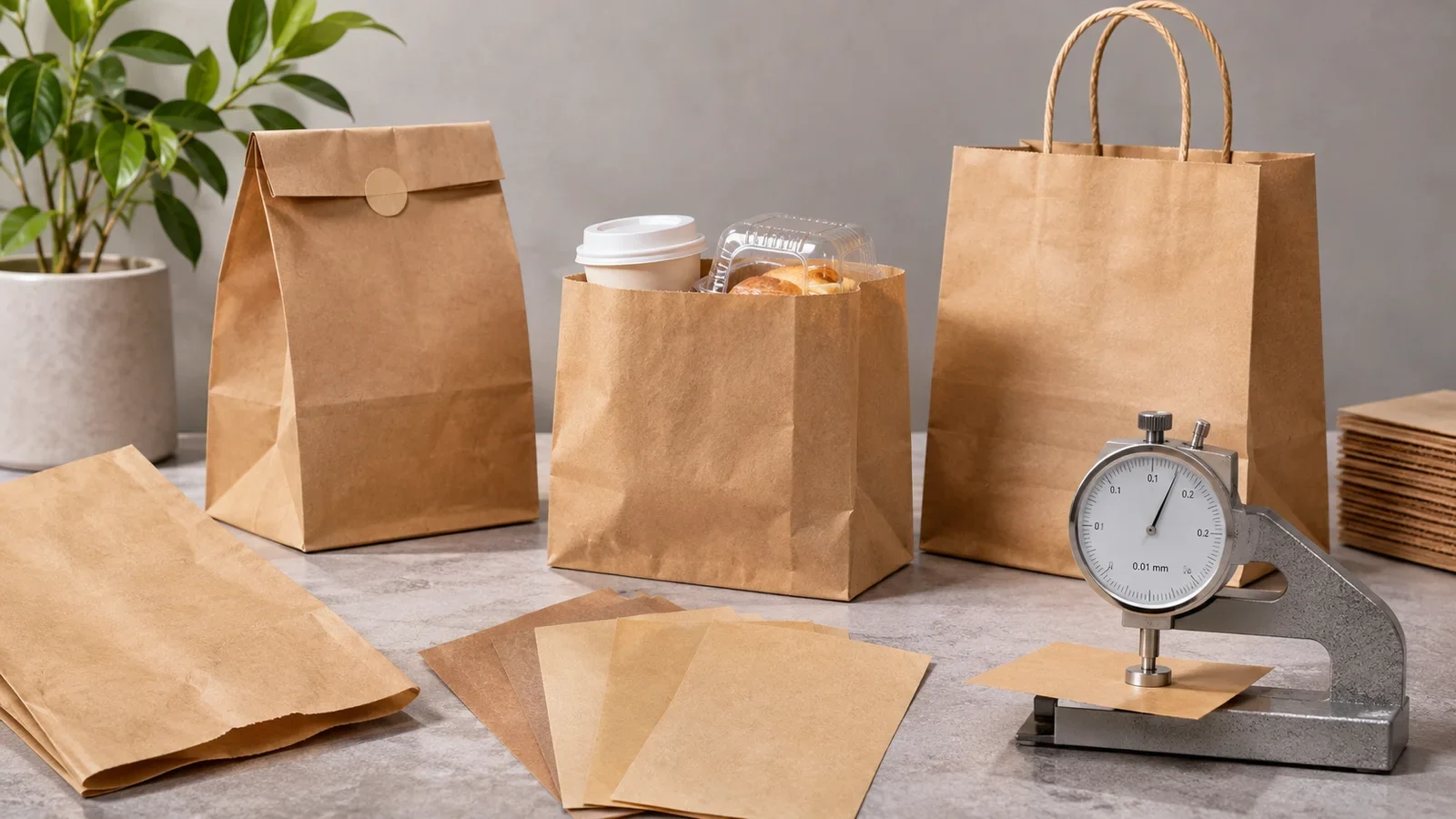
Paper thickness can be measured using methods described in ISO 534:2011. Papers with the same GSM can have different thicknesses due to fiber type, density, refining, calendering and other manufacturing factors.
3. Choose by what your customers will pack
A café handing over a dry pastry faces a different packaging challenge from a takeaway restaurant placing two meal containers, napkins and cold drinks in a bag. The question is not “What is the best GSM?” but “What bag structure and paper specification pass our real packing conditions?”
| Use case | Primary risk to check | Sample test |
|---|---|---|
| Bakery and dry snacks | Creasing, bottom opening, handling at counter | Repeated filling and lifting at normal weight |
| Takeaway food boxes | Uneven loads and heavy pressure at the base | Test the fully packed order and bottom seams |
| Cold beverages and desserts | Condensation and moisture contact | Check performance after realistic exposure |
| Custom printed retail packaging | Scuffing, folds and brand-color appearance | Inspect printed production-representative samples |
| Oily foods | Oil staining, barrier and direct food contact | Discuss an appropriate grease-resistant material |
For oily meals, choosing a heavier untreated paper does not automatically provide the necessary grease barrier. Ask for material options and evaluate food type, contact temperature and duration. If the bag is only outer packaging and the food stays inside a separate container, state that in your inquiry.
4. Why bag size and square-bottom construction matter
Even a well-selected paper grade can fail at the wrong bag size. Containers that sit on top of a folded seam, push the sides outward or barely pass through the opening create unnecessary stress. A square-bottom bag should stand adequately for the intended filling process, and its base should support the actual packed products.
- Measure the biggest packed order. Include lids, boxes, sauce containers and any protruding components.
- Check the floor of the bag. Compare the load footprint with the bag’s usable flat-bottom area.
- Check the opening and height. Staff should not need to force boxes or stretch the bag to finish packing.
- Check where the load sits. A tall, unstable stack may stress the upper walls or make carrying awkward even if the paper is heavy.
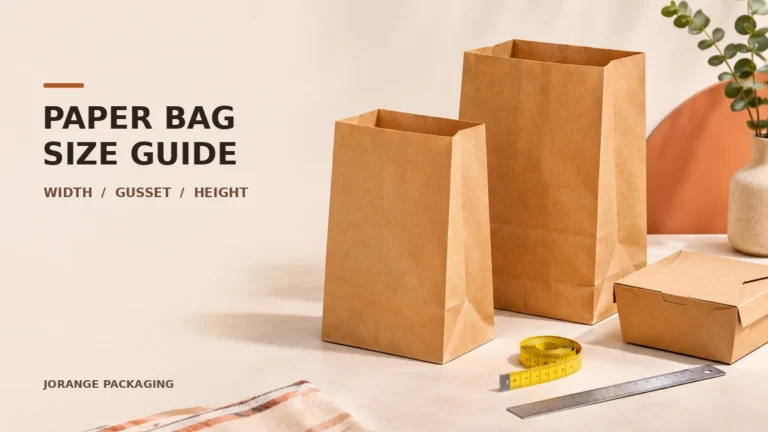
For width, gusset and height terminology, see our paper bag sizing guide. A good specification considers both the sheet material and the converted bag dimensions.
5. A practical bag-strength sample test
Ask for two or three candidate samples that differ in paper weight, grade or construction. Use comparable samples from the intended production model rather than generic paper swatches. The following in-house checks help reveal obvious weaknesses but do not replace documented laboratory load or quality testing.
- Define the load. Use a full, realistic takeaway order including the actual food containers. Record its weight, shape and distribution.
- Fill the bag normally. Place the order into each candidate bag as staff would during service. Note bottom sagging, excessive bulging or difficult insertion.
- Lift and carry carefully. Perform ordinary counter-to-door handling without dangerous overload or deliberately violent shaking. For bags without handles, use the intended support method.
- Observe bottom and seams. Look for changes at folds, glue lines and sharp container corners. Do not rely on paper GSM as a substitute for construction quality.
- Repeat under realistic conditions. Condensation, a damp counter or warm food may change the results. Test the conditions relevant to your operation.
- Document several repeats. Photograph any damage, note the test weight and compare multiple samples from each candidate design before approval.
| Sample record | What to note |
|---|---|
| Bag identifier | Model, dimensions, GSM, paper grade, coating if any |
| Order condition | Number of boxes, total load, dry/damp handling |
| Performance | Base sag, seam damage, creasing, tears, slipping items |
| Appearance | Print scuffing, wrinkling, visible staining |
| Decision | Approve, adjust bag size or request another material |
6. GSM and custom printing should be approved together
Paper color and surface texture can change how a logo looks. Light ink on brown kraft may have different contrast than the same artwork on white stock. Dark solid prints and fine lines also deserve physical proofing. Your chosen material and print artwork should therefore be reviewed as one combination, not in separate decisions.
Ask the supplier which side of the bag will be printed, where folds and glue lines fall, and whether a specific artwork color is practical for the selected material. Our paper bag artwork checklist covers files, bleed, color references and proof approval in greater detail.
7. Food-contact and material claims need their own evidence
The terms “kraft,” “recycled,” “thick,” and “grease-resistant” describe different characteristics. None of them alone proves that an individual finished bag is suitable for direct food contact, compostable, recyclable everywhere or acceptable for hot oily foods.
If food will touch the bag directly, identify the intended contact conditions and destination market. The EU food-contact framework and relevant national or material-specific rules may need to be considered. Ask for applicable documents tied to the actual paper grade, coating, printing and intended use.
8. Compare wholesale quotes fairly
Two bags with the same outside dimensions may have different prices because of GSM, source paper, printing, coatings, packing quantities and production arrangements. For a useful comparison, ask both suppliers to quote the same functional specification and order quantity.
Consider the delivered cost per usable bag: the unit price, freight and storage plus loss from breakage, repacking and wasted stock. The heaviest option is not automatically the most economical; the lightest option is not automatically inadequate.
9. What to include in a paper bag RFQ
- Finished bag dimensions: width, gusset and height, plus square-bottom design.
- The actual packed items and approximate total order weight.
- Paper preference: kraft or white, GSM target if known, and any treatment requirements.
- Direct or indirect food-contact use, temperature and exposure conditions.
- Brand artwork, color references and print coverage.
- Estimated order quantity, cartons, destination and required documents.
- Request for production-representative samples and defined performance tests.
Explore the Jorange Packaging paper bag range for open-top, square-bottom kraft formats and customization review. Exact paper weights, dimensions, material options and commercial terms are confirmed for each proposed bag model.
Frequently Asked Questions
Is 120 GSM always stronger than 80 GSM paper?
Not automatically. It is heavier per unit area, but bag strength also depends on the paper grade, fiber properties, structure, seams, dimensions and service conditions.
Does GSM tell me the thickness of a paper bag?
No. GSM measures grammage. Thickness is a separate measurement, and sheets with equal GSM may have different caliper or bulk.
What GSM should I choose for takeaway food bags?
Start with the size and weight of the complete order, then sample appropriate paper grades and finished bag constructions. Do not rely on a universal GSM rule for every menu.
Can a high-GSM kraft bag hold greasy food directly?
Higher GSM does not establish grease-barrier or food-contact suitability. Ask about the intended material, treatment and supporting documentation.
What matters more for a heavy takeaway order: GSM or the bottom seam?
Both need review, along with bag geometry and load distribution. A strong paper sheet cannot compensate for an unsuitable or poorly constructed base.
Can Jorange confirm a specific GSM for my custom paper bag?
Send your dimensions, application, approximate load, quantity and paper preference. Available grades and the selected bag specification can then be reviewed during quotation.
Choose the Bag Your Order Actually Needs
Share your packed product dimensions, load, preferred paper appearance, artwork and order quantity with Jorange Packaging. We can help review suitable square-bottom paper bag options and sample requirements.
Request a Paper Bag Quote →