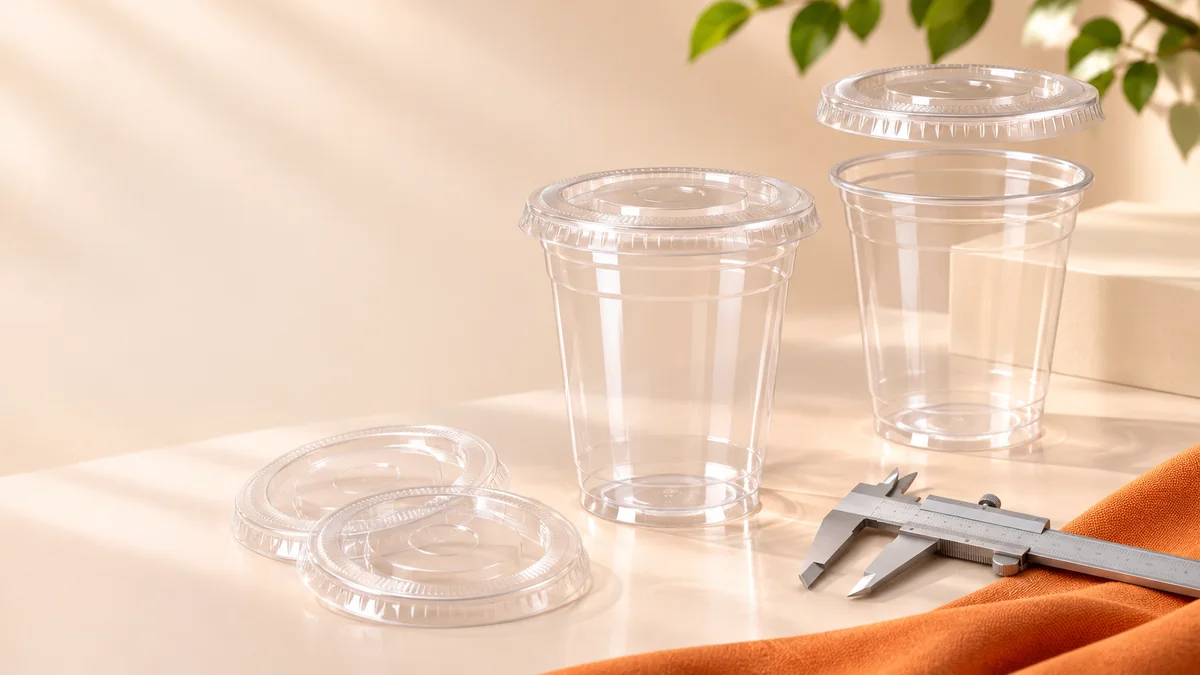
Why Same-Size PET Cups and Lids Still Leak: Mold Fit & Quality
PET Cold Cups / Buyer Quality & Sourcing Guide
PET cup lid fit is not guaranteed by a matching number on two product listings. A cup and a lid can both be sold as “98 mm,” yet feel loose, fail to snap on evenly or leak when the filled cup is carried.
One practical lesson from packaging sourcing is that different factories may use different molds and rim designs. Sometimes the parts are simply incompatible. Sometimes the problem is inconsistent cup or lid quality—even when the items appear to be the right size.
Our practical recommendation: Where possible, buy PET cups and their confirmed matching lids from the same manufacturer or one supplier responsible for the tested pair. That reduces cross-factory uncertainty, but it is not a guarantee of leak-proof performance. Samples and production quality still matter.
This article focuses on cross-factory fit failures, quality checks and purchasing decisions. For a more general introduction to lid types and basic sizing, see our separate PET cup lid size and fit guide.
Why Can Two “98 mm” PET Cups Need Different Lids?
Numbers such as 90 mm, 95 mm and 98 mm are useful nominal size labels, not a universal guarantee that independently manufactured parts are interchangeable. An actual snap-on lid grips a three-dimensional rim—not a single number.
The cup side
Actual rim outside diameter, rim curl or lip shape, thickness, roundness, stiffness and dimensional consistency all affect the connection.
The lid side
The locking channel, skirt depth, flexibility and molded shape determine how far the rim seats and whether the lid stays engaged.
Imagine two factories each making a “98 mm” PET cup. Factory A uses a rim geometry designed around its own flat and dome lids. Factory B has a different forming mold and rim profile. A lid from Factory A may click onto Factory B’s cup but still leave a small gap at part of the edge. Or it may be so tight that staff cannot close it consistently.
Important: This is an illustrative sourcing scenario, not a claim that any particular factory or dimension has failed. No single tolerance value should be assumed for every cup and lid design; request the drawings and agreed limits for the actual models.
Four Reasons PET Cups Leak Even When the Diameter Matches
1. Different molds and incompatible rim profiles
Cup makers can use different forming tools and rolled-rim profiles. Lid makers also design their locking channels around particular rim shapes. The two parts may have matching nominal diameters yet insufficient locking engagement—or excessive interference that makes them hard to close.
2. Poor cup or lid consistency
Cross-factory incompatibility is not the only cause. A rim can be oval, locally deformed or inconsistent around its circumference; a lid can be warped or formed unevenly. Variation between manufacturing lots can make a pairing that worked in one trial fail in the next.
3. A lid that is not fully seated
A quick push in the middle of a lid may not engage every section of the rim. Staff may encounter a lid that seems closed on one side but remains raised on the other. Overfilling, liquid on the rim or pressing the cup’s sidewall too hard can make this worse.
4. Leakage through the opening, not the rim
Some flat lids have straw slots and some dome lids have openings for toppings. Liquid escaping through an intentional opening is different from liquid escaping between the lid and cup. A tight rim seal should not be described as “100% leak-proof” if the design is open at the top.
Buyer tip: When reporting a leak, first identify where the liquid appears: around the cup rim, at the straw opening, or through a damaged cup. Each points to a different possible fix.
Why Buying Cups and Lids Together Often Works Better
For a restaurant chain or packaging importer, sourcing cups and lids as one qualified set can be more reliable than selecting two products from separate catalogs by diameter alone. Here is why.
- Known pairing: a manufacturer can recommend a lid model already designed or checked for the exact cup series.
- Fewer unknowns: buyers do not need to infer compatibility between separate tooling systems.
- Clear responsibility: one supplier can be asked to confirm the combined fit, rather than two suppliers blaming each other’s component.
- Easier reordering: approved cup and lid codes can be kept together so that a later order does not accidentally mix incompatible versions.
However, “same supplier” is not always “same factory,” and even a true single-factory pairing can have defects. The strongest recommendation is therefore buy a documented, sample-approved cup-and-lid combination—preferably through a supplier who takes responsibility for the whole set.
If splitting the order between two factories is necessary, it can still work. The buyer should send physical samples, compare the rim and lid profiles, and approve the exact combination before mass production.
A Practical PET Cup and Lid Fit Test Before Bulk Ordering
Do not approve a cup-and-lid set because one empty cup passes a quick snap test. Use representative samples and the intended cold-beverage service conditions. The following is a practical buyer screening checklist, not an official laboratory standard or a substitute for an agreed quality-control protocol.
Identify both parts. Record the cup SKU, lid SKU, suppliers, nominal rim size, lid design and sample lot where available.
Inspect dimensions and visible quality. Check the actual rim profile, roundness and surface for warping or damage. Ask the manufacturer for the drawing and permitted production variation; avoid squeezing a flexible rim hard with measuring tools.
Close the lid normally. Have a staff member fit the lid as they would during service. Check all around the circumference for raised sections, rocking, cracking or unusually high force.
Test a filled cup. Use cool water or the intended cold beverage, an agreed fill level and the real ice or topping arrangement. Check for rim seepage while carrying, gently tilting and placing the cup in its normal carrier.
Match the test to the lid type. A no-hole lid may allow a controlled tilt or inversion check where appropriate. A straw-slot or open dome lid should not be judged as a sealed container by turning it upside down.
Repeat across samples and batches. A single successful cup proves very little. Check more than one sample and, when possible, more than one production lot. Agree on acceptance criteria with the supplier before the bulk order.
For a product that will travel through delivery networks, add a realistic handling simulation rather than relying solely on a tabletop check. Do not use hot liquids with a PET cold cup unless the specific product is rated for that use.
What the Failure Looks Like—and What to Check First
| Observed problem | Possible cause | First action |
|---|---|---|
| Cap feels loose or spins | Insufficient rim engagement, wrong lid channel or variation in dimensions | Confirm the cup and lid model codes; compare a known matched sample |
| One edge will not snap down | Rim out of round, warped lid or incompatible geometry | Inspect the full rim and try another sample from the same and a different lot |
| Lid is very hard to press on | Excessive interference or incorrect lid design | Do not force it; request the designed lid pairing and check for damage |
| Liquid escapes around the rim | Local gap, incomplete seating, deformation or handling stress | Mark the leak location and repeat the filled-cup test under controlled conditions |
| Liquid escapes through straw hole | Open lid design, overfilling or movement | Consider another lid style and realistic transport conditions |
| Only some cartons show problems | Lot variation, handling damage or mixed SKUs | Record affected lot numbers; compare retained samples from each batch |
Symptoms suggest areas to investigate; they do not establish a root cause without inspection and testing.
If You Must Buy Cups and Lids from Different Factories
Sometimes an importer already holds cup inventory or a chain wants to retain a specific lid. In that case, the safer process is physical cross-supplier matching:
- Send your existing finished cup—or the exact current lid—to the replacement supplier, not just a photo showing “98 mm.”
- Ask for the rim profile drawing, lid channel design and the relevant permitted tolerances for those particular SKUs.
- Request samples from the proposed production material and test the exact combination under intended service conditions.
- Record the approved cup/lid pairing and require notification if tooling, materials or production specifications change.
- On incoming stock, spot-check the supplied cup-and-lid pair rather than assuming the first approved sample covers all future lots.
This takes more coordination than a single approved set, but it is much safer than buying purely by catalog diameter.
Wholesale RFQ Checklist: What to Send Your Cup Supplier
A useful inquiry gives the supplier enough information to recommend a compatible combination instead of guessing from the nominal size.
Copy this information into your RFQ:
- Cup capacity and actual cup model or sample
- Nominal rim diameter plus drawing or measured rim details, if available
- Preferred lid style: flat, dome, straw slot or no-hole
- Drink type, serving temperature, fill level, ice or toppings
- Whether the cups and lids will be used for takeaway, delivery or in-store service
- Estimated quantities for cups and matching lids
- Delivery country, custom printing needs and sample-testing expectations
Looking for a matched cold-cup system? Explore Jorange PET cups, then share your required capacity and lid style through our custom packaging inquiry form. Exact availability and compatible lid models should be confirmed in the quotation.
Frequently Asked Questions
Do all 98 mm PET cup lids fit all 98 mm cups?
No. A shared nominal diameter does not establish identical rim shapes, locking channels or production tolerances. Test the exact cup and lid combination.
Is it better to order PET cups and lids from the same factory?
Often yes, because a factory may offer a lid specifically matched to its cup series and can help verify the combined fit. However, even same-factory parts require sample testing and quality control; the supplier should confirm the tested SKU pairing.
Why does my lid click on but still leak?
An audible click does not prove every point around the rim is engaged. Check for local gaps, cup deformation, lid warping, overfilling and intentional drink openings.
Can a good cup still leak because of a poor-quality lid?
Yes. An incorrectly formed, warped or inconsistent lid can fail to engage a correctly made cup. The reverse is also possible: an inconsistent cup rim can defeat a good lid.
Can I keep my current cups and buy only replacement lids?
Possibly. Send an actual cup sample and model details to the new lid supplier, then test several finished cup/lid pairs before committing to a bulk lid order.
Does a tight lid mean a PET drink cup is spill-proof?
Not necessarily. A lid might fit well but have a straw or sip opening, and ordinary handling can still cause splashing. Describe the intended application and test the system rather than relying on an absolute leak-proof claim.
The Takeaway: Buy a Matched System, Not Just a Diameter
A cup and a lid may both carry the same millimeter size and still fail together because of different molds, rim profiles, lid channels or quality variation. This is exactly why a purchasing decision should be based on the approved cup-and-lid set, not two independent catalog labels.
Our preferred sourcing approach: choose a supplier that can provide and verify the matched PET cup and lid models, ideally through the same manufacturing operation. For cross-factory orders, treat physical compatibility testing as a required approval step, not an optional extra.
Further technical reading: Cup-and-lid fit testing and failure diagnosis and PET cup and lid selection factors. These are external industry references, not third-party certification of Jorange products.
Need PET Cups and Matching Lids?
Tell us which cups, lid style and application you need. We can review your requirements and discuss available matching options before you place a wholesale order.