Custom Burger Wrap Sizes: How to Choose the Right Sheet
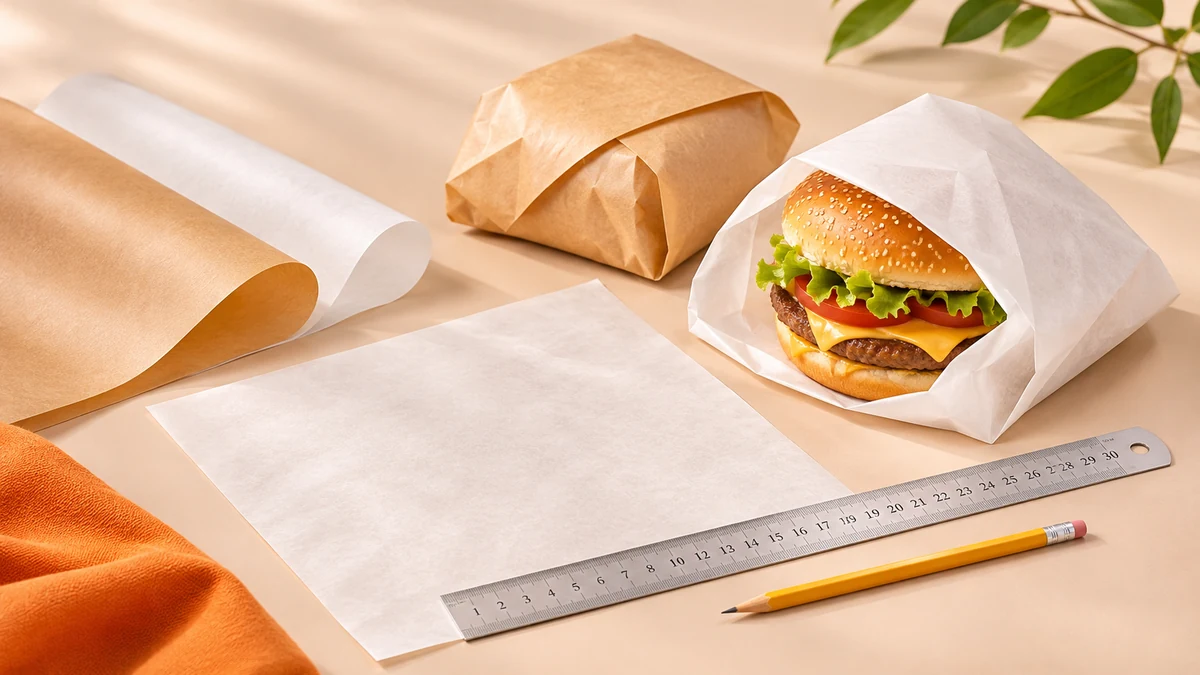
Custom burger wraps should be sized around the food and the way your team wraps it—not just a supplier’s standard sheet list. A sheet that looks generous on a counter may leave an oily cheeseburger partly exposed after folding. An oversized sheet can hide your logo, add material cost and slow down service.
The practical solution is to test real burgers with unprinted sample sheets, mark the visible print area after wrapping, and approve the paper and artwork together before a wholesale order.
1. Why there is no universal burger wrapping paper size
Two burgers with similar bun diameters can need different wrapping sheets. A thick double cheeseburger has more sidewall height than a flatter sandwich; tall lettuce or a paper tray changes the fold; and a burger packed for delivery may require a tighter closure than a burger served in a basket.
Before requesting custom burger wraps, measure your actual finished menu item and decide what the paper should do: a full hand-held wrap, a partial sleeve, or a tray liner. Do not copy a competitor’s size without testing the same serving format.
| What to measure | Why it matters | What to record |
|---|---|---|
| Burger maximum width | Determines how far the paper must cover the sandwich | Across the widest toppings or bun |
| Finished serving height | Higher burgers use more sheet material at each side | From base to highest topping |
| Wrap style | Changes needed overlap and folding allowance | Full wrap, half-wrap or liner |
| Grease and sauce exposure | Influences grade, barrier and handling tests | Type of food, sauces, serving temperature |
| Service time | Changes how the wrapped item behaves | Eat-now pickup or delivery journey |
2. Choose the wrapping method before the sheet dimension
| Use | What the paper needs to achieve | Best sample check |
|---|---|---|
| Full burger wrap | Keep sides covered with a stable fold and usable opening | Can staff close and reopen it without tearing? |
| Half wrap or sleeve | Shield hands while leaving part of the burger visible | Does the sleeve stay in place while eating? |
| Tray or basket liner | Separate food from its serving surface and show branding | Does the liner stay flat without obstructing service? |
| Inside a takeaway box | Help with handling within an outer container | Does the wrapped burger still fit the box and close properly? |
The same printed sheet may be suitable for more than one use, but it must pass each use case separately. For example, a tray liner that looks attractive when flat may not leave enough length for secure full wrapping.
3. A five-step paper-sheet fit test
- Prepare real servings. Use the burger as sold, including cheese, sauces, toppings and any inner tray or sleeve. Photograph its assembled height and width.
- Cut multiple trial sheets. Start with two or three candidate dimensions supplied by the manufacturer or cut from sample paper. Mark the width and length on each sheet so results are traceable.
- Repeat the actual wrapping motion. Let the employees who normally pack orders perform several wraps. Check whether the paper covers the food, holds its fold and opens comfortably for the customer.
- Observe normal service conditions. Test the wrapper with the intended serving temperature, sauces and expected holding time. Check for oil marks, dampness, tearing and excessive trapped steam. Do not treat any unverified sheet as leakproof.
- Approve the dimension and orientation together. Photograph the final wrapped product from front, back and top. Note the fold direction and where your logo remains visible.
4. Where should the logo go on custom printed burger wraps?
A flat artwork proof does not show how printing appears on a finished burger. Folding can hide a centered logo, turn text upside down, or make only a narrow strip of the design visible. This is why printed burger wraps benefit from a physical wrap mock-up before the print run.
Single logo versus repeating pattern
A single large logo works when the placement and folding sequence are consistent. A repeating pattern may be easier to recognize when different team members fold sheets in slightly different ways. Neither approach is always better: take a photo of a finished wrap and choose the layout that remains clear in your real service.
Print side and food contact
Tell the supplier which side of the printed sheet will touch food. Ink, coating and other materials must be assessed for the intended finished food-contact application; printing on an exterior surface is not by itself proof that the whole converted wrapper is suitable for every use. Confirm destination-market requirements and documentation for the exact specification.
Detailed designs and dark ink coverage
Fine text, heavy solid-color blocks and repeated folds deserve physical approval. Request a print proof on the selected paper grade, and check text edges, contrast, logo position and whether the printed surface changes after normal handling. Screen previews cannot show every issue associated with paper texture or finished printing.
5. Grease resistance is a separate buying decision
A sheet can be the correct size but still disappoint when exposed to hot oil, melted cheese or sauces. Grease-resistant refers to performance of a particular paper construction or treatment under given conditions; it does not mean every kraft sheet will stop oil indefinitely. Ask about paper composition, coatings and the kind of use the finished sheet has been evaluated for.
For U.S.-bound food-contact wrappers, the FDA has described the phase-out of PFAS-containing grease-proofing agents in paper packaging. A buyer should request evidence relevant to the actual item instead of assuming that words such as “greaseproof,” “PFAS-free” or “food grade” automatically establish compliance. Read the FDA’s food-packaging update.
For EU-bound food packaging, buyers should also evaluate the applicable food-contact framework and finished product specifications. EU Regulation (EC) 1935/2004 provides the general framework. Compliance needs to be reviewed for the specific materials and intended contact conditions.
6. Use a simple acceptance scorecard
A repeatable scorecard makes it easier to compare two papers without relying on appearance alone. Carry out trials with comparable burgers, team members and service conditions.
| Check | What a buyer should observe | Pass / revise |
|---|---|---|
| Coverage | Food stays covered at the required edges | Record result |
| Ease of wrapping | Staff can fold the sheet consistently without forcing | Record result |
| After-service condition | No unacceptable tearing, softening or grease transfer | Record result |
| Brand visibility | Printed logo or pattern remains legible after folding | Record result |
| Secondary packaging fit | Finished wrap fits the intended bag, tray or box | Record result |
This is a practical restaurant sample check, not a laboratory barrier-performance certificate. For larger or sensitive programs, agree on objective acceptance criteria and any formal test reports needed before production.
7. Compare costs per wrapped burger—not only per printed sheet
Buying an unnecessarily large paper sheet adds material and may increase packing time. A sheet that is too small can create rewraps, double-layering, poor brand presentation or additional waste. Ask your supplier for quotations based on the same material, print coverage, sheet count and delivery terms, then compare how each candidate performs in service.
8. What to send a custom burger wrap supplier
- Finished burger dimensions and a photo of the wrapping style.
- Proposed sheet width and length, with the intended fold direction.
- Food type, grease/sauce level, serving temperature and expected contact time.
- White or kraft paper preference and desired grease performance.
- Logo/vector artwork, color references and print-side requirements.
- Estimated sheets per order, destination country and document needs.
- A request for printed samples and agreed acceptance criteria where needed.
Jorange Packaging currently lists a 10,000-sheet minimum order quantity for its custom burger wrapping paper. Final dimensions, available materials, print method and lead time are reviewed for the selected order. If your store is still deciding between wrapping sheets and cartons, consider how the wrap and box formats differ in handling and delivery.
Frequently Asked Questions
What size paper do I need to wrap a burger?
There is no dependable universal size. Measure the finished burger, choose your full-wrap or half-wrap method, test candidate sheets and approve the actual fold coverage before ordering.
Can one custom burger wrap size serve every menu item?
Sometimes, but tall or large burgers can need more overlap. Test the largest and smallest items as well as how much paper staff waste on the smaller serving.
Should I choose a square or rectangular burger wrap?
Either can work depending on the fold and presentation. Try both shapes with actual burgers; the practical result matters more than the label.
Will greaseproof paper stop every oil stain?
No paper should be described as indefinitely oil-proof without relevant evidence. Choose a material based on the actual food, temperature, contact period and approved tests.
Will a large centered logo appear on the finished wrapped burger?
Not necessarily. Fold a printed or marked mock-up first and photograph what a customer sees. Adjust logo orientation or use a pattern if the logo disappears into a fold.
What is the minimum order for Jorange custom burger wraps?
The currently published starting MOQ is 10,000 sheets. Confirm your sheet specification and print requirements when requesting a quotation.
Make the Wrap Fit Your Burger and Your Brand
Send Jorange Packaging your finished burger dimensions, wrapping style, artwork, paper preference and estimated order quantity. We can review suitable custom wrapping paper options and the details needed for an accurate quote.
Request a Custom Burger Wrap Quote →