French Fry Packaging for Takeaway: How to Reduce Soggy Fries
Wholesale Buying Guide · French Fry & Takeaway Packaging
French fry packaging has a difficult job: protect a hot, oily food without trapping so much steam that its crisp surface softens before the customer opens the order. A good-looking carton alone cannot solve that problem. The packaging shape, available airflow, grease resistance, portion size and outer delivery bag all affect the outcome.
Why Do French Fries Get Soggy in Takeaway Packaging?
Freshly fried potatoes have a crisp outer layer and a moist interior. Their texture depends partly on the movement of water during frying and afterwards. Food-science research describes the link between moisture in the crust and the crisp texture consumers expect. After cooking, hot fries can continue releasing water vapor into their surroundings.
Put those fries into a tightly closed, poorly ventilated container and the vapor has fewer places to go. As the air and packaging cool, moisture can accumulate on internal surfaces. Condensation and contact with humid air can soften the food’s crust. The Idaho Potato Commission specifically cautions foodservice operators against trapping steam when packing hot fries.
This does not mean maximum ventilation is always the answer. More airflow can also let heat escape; an open carton can spill or become compressed inside a delivery bag. A good packaging choice balances texture, temperature, handling and the food’s actual journey.
French Fry Packaging Formats: Which Should You Compare?
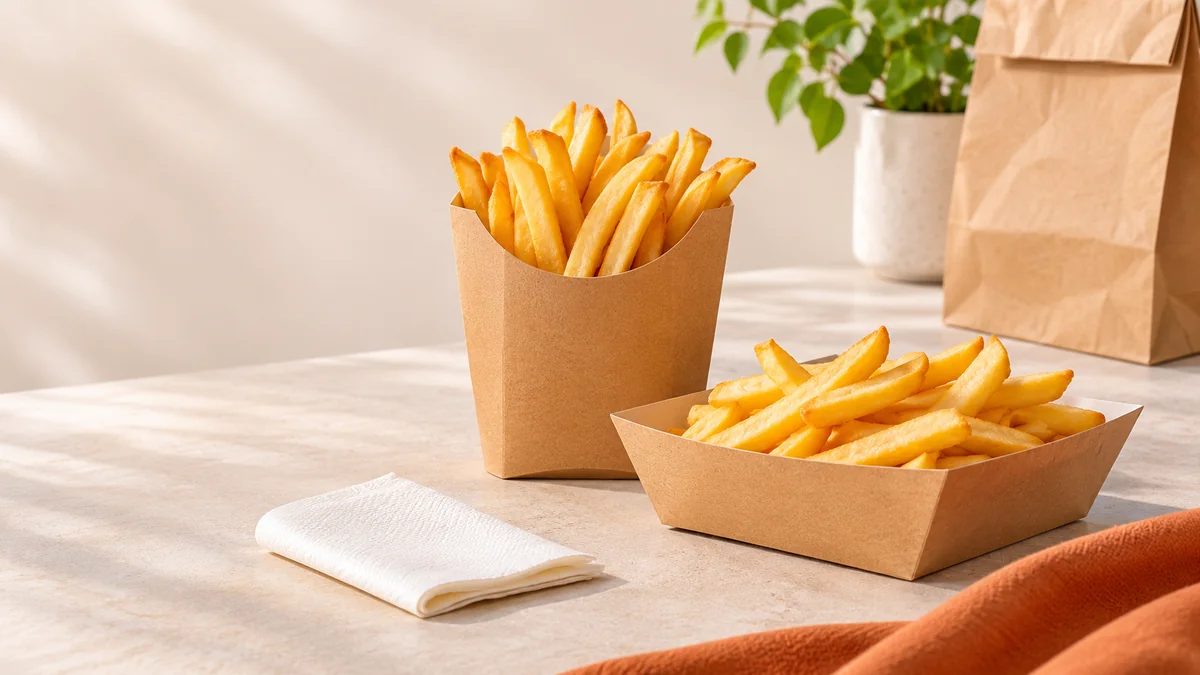
Jorange Packaging’s French Fry Boxes collection currently presents open-top fry cartons and paper fry trays. These are sensible starting points for a sampling discussion. A fully enclosed or ventilated design can also be considered in a broader packaging search, but its availability, tooling and food-contact specifications must be confirmed rather than assumed.
| Format | Where it is useful to test | Potential advantage | Watch-out |
|---|---|---|---|
| Open-top fry carton / scoop | Counter pickup, short takeaway trips, food trucks | Easy portioning and an exposed top for steam to escape | Spillage, cooling and crushing when carried with other items |
| Open paper fry tray | Immediate serving, dine-in and snack presentations | Wide opening and convenient eating access | Less containment in a crowded delivery bag |
| Covered or vented carton (supplier confirmation required) | Longer transport where containment matters | Potential to protect the portion while allowing controlled steam release | Vent position, condensation, heat loss and food-contact suitability all need testing |
These are use-case comparisons, not measured performance rankings or promises that every listed structure is available from Jorange.
For courier delivery, test the inner fry container inside the real outer takeaway bag. A carton that vents well on the counter may behave differently inside a tightly folded bag with hot burgers, sauces and drinks. Keeping wet sauces separate during the test helps show whether moisture comes from the fries, the other foods or both.
Four Buying Details Beyond the Box Shape
Steam management
Compare open areas and any approved vent features. Look for condensation, damp fries and moisture collecting in corners during your delivery test.
Grease resistance
Inspect whether oil stains, soaking or softening weaken the board. Ask which paperboard or barrier option is suitable for the actual fatty-food contact conditions.
Portion and headspace
Test the real cooked serving by weight. Overfilling can reduce available space and make it difficult to close or carry the container cleanly.
04. Handling and the outer bag
Finally, assess the full handoff process: how quickly staff can fill the carton, whether it stands upright, how well the printed surface looks after contact with grease, and whether the container shifts in a takeaway paper bag. A tray that performs well on a counter may need a different carrier arrangement for scooter delivery.
Be cautious of broad claims such as “greaseproof means leakproof” or “a heavier paperboard will always keep fries crisp.” Grease resistance and moisture ventilation solve different problems. Food-contact suitability also depends on the complete paper, any coating, inks and the intended conditions of use. The US FDA’s food-packaging guidance explains why packaging components need to be assessed for their specific food-contact uses.
A 30-Minute French Fry Packaging Sample Test
Before committing to custom print plates or a large quantity, run a small side-by-side trial. This is a proposed buyer evaluation method, not a standardized laboratory test or a claimed Jorange product result.
- Choose comparable samples. Select two or three carton/tray configurations, label them A, B and C, and record dimensions, material and whether an outer bag is used.
- Keep the food consistent. Use the same type of fries, preparation method, cooked portion weight and approximate packing time for each sample. Note sauces or seasonings separately.
- Re-create the journey. Pack samples as staff normally would; place each in the planned takeaway bag and carry it through a representative route or handling sequence.
- Check at useful intervals. Evaluate an initial sample, another after about 10 minutes and another after 20 minutes; add a 30-minute checkpoint only if that reflects real delivery times. Use separate portions if repeated opening would alter the result.
- Record observations, not just preferences. Photograph the opened containers and document steam condensation, perceived crispness, warmth, oil stains, carton stiffness and any spills.
| What to assess | Simple observation method | Record |
|---|---|---|
| Texture | Compare a consistent fry sample against the just-cooked reference | Crispness score 1–5 plus notes |
| Condensation | Look inside carton, lid (if used) and outer bag | None / light / heavy; photo |
| Grease performance | Inspect bottom, folds and outside surface | Stains, seepage, softening |
| Delivery handling | Check for tipping, compression and spills | Pass / needs changes, with reason |
| Serving experience | Check access, portion appearance and temperature impression | Staff/customer feedback |
Suggested timings and scores are practical trial choices, not evidence that fries remain crisp for a particular length of time. Follow your own food-handling and safety procedures during any taste or transport test.
Use the same evaluation sheet for the approved sample and a later incoming delivery of cartons. That makes a packaging reorder easier to compare than relying on memory or a photograph from the first quote.
Wholesale French Fry Packaging: Specifications to Confirm
Jorange’s current fry-box page lists an MOQ of 10,000 pieces for custom French fry boxes, with size and printing options reviewed per project. Its displayed 90 g and 120 g portion illustrations are approximate references, not guaranteed amounts each carton holds for every fry cut or cooking style. Verify actual fill weight using your product.
- Preferred format: open-top carton or tray; any proposed closure or venting requirement
- Measured dimensions or a target cooked serving weight and a sample photo
- Food type, oil/grease expectations, takeaway duration and use of an outer bag
- Paperboard and food-contact documentation requirements for the destination market
- Logo file, print colors, artwork placement and estimated order quantity
- Sample request, packing quantity per carton and delivery destination
Example request to send a supplier
“We need custom printed French fry cartons for takeaway orders. Please quote an open-top carton suitable for our standard cooked fry portion of [weight], with dimensions to be finalized after sampling. We would like to compare grease-resistance options and test the cartons inside a paper delivery bag for a 20-minute route. Please confirm MOQ, artwork requirements, available samples, food-contact documentation, carton packing and shipping terms.”
Replace the bracketed value with your real serving weight; this is an illustrative request, not a confirmed specification.
When choosing printed packaging, approve the physical structure first, then check the brand artwork against its actual print layout. A beautiful logo cannot compensate for a carton that spills, folds poorly or becomes damp during normal delivery.
French Fry Packaging FAQ
Do vent holes always keep French fries crispy?
No. Ventilation may help reduce trapped moisture, but texture also depends on the fries, cooking process, hold time, carton geometry and the outer bag. Too much airflow may reduce heat retention. Request samples of any proposed vented design and test them.
Are open-top fry boxes better than paper trays?
Neither is universally better. Open-top cartons can be convenient for upright, quick-service portions, while trays provide easy access during counter service. Test your expected serving and handoff method rather than ranking them by appearance alone.
What size French fry box is right for 90 g or 120 g portions?
Those weights may appear in size illustrations, but they are not universal carton capacities. Different fry cuts, seasoning and packing styles change how a portion sits. Weigh your cooked portion, fill physical samples and confirm dimensions before ordering.
Is grease-resistant paper automatically food-contact compliant?
No. The paperboard, barrier, inks and intended temperature/contact conditions need appropriate review for the destination market. Ask the supplier for documentation relevant to the exact selected construction.
Can I order printed French fry packaging with my logo?
Jorange Packaging lists custom printed fry carton and paper tray options subject to specification review. Supply your artwork, preferred dimensions, quantities and destination so print feasibility can be confirmed.
What is the minimum order quantity for Jorange French fry boxes?
The current Jorange French Fry Boxes product page lists a 10,000-piece MOQ. Final manufacturing, sampling and order terms are confirmed against the selected design.
Need Custom French Fry Boxes for Your Takeaway Brand?
Share your portion weight, container style, printed design, order volume and target market. Jorange Packaging can review suitable fry carton and tray options and discuss the samples needed before a bulk order.
Request a Fry Packaging QuoteExplore the existing range: Custom French Fry Boxes.
References & scope: The moisture/texture background draws on 2024 food texture research and the Idaho Potato Commission’s foodservice advice. Food-contact considerations reference FDA guidance. Product formats, the indicative serving chart and MOQ reference the Jorange French Fry Boxes page, reviewed November 2026. Illustrative tests and sample checklists are recommendations, not results from a Jorange laboratory or production batch.