Wholesale Buying Guide · Coffee & Takeaway Packaging
Paper cup sizes are easy to compare by name—8 oz, 12 oz and 16 oz—but much harder to choose correctly for a busy café. The label is only a starting point. The cup’s stated capacity, your actual drink recipe, its rolled rim and its matching lid all affect what customers experience.
Paper Cup Sizes Compared: 8 oz, 12 oz and 16 oz
The comparison below combines the mathematical conversion of US fluid ounces with the current reference single-wall white cup specifications published on Jorange’s paper cups product page. Those two columns are intentionally different: a nominal size name is not the same as a listed manufacturing capacity.
| Cup label | US fl oz converted to mL | Jorange listed reference capacity | Reference rim × height × base | Common café planning use |
|---|---|---|---|---|
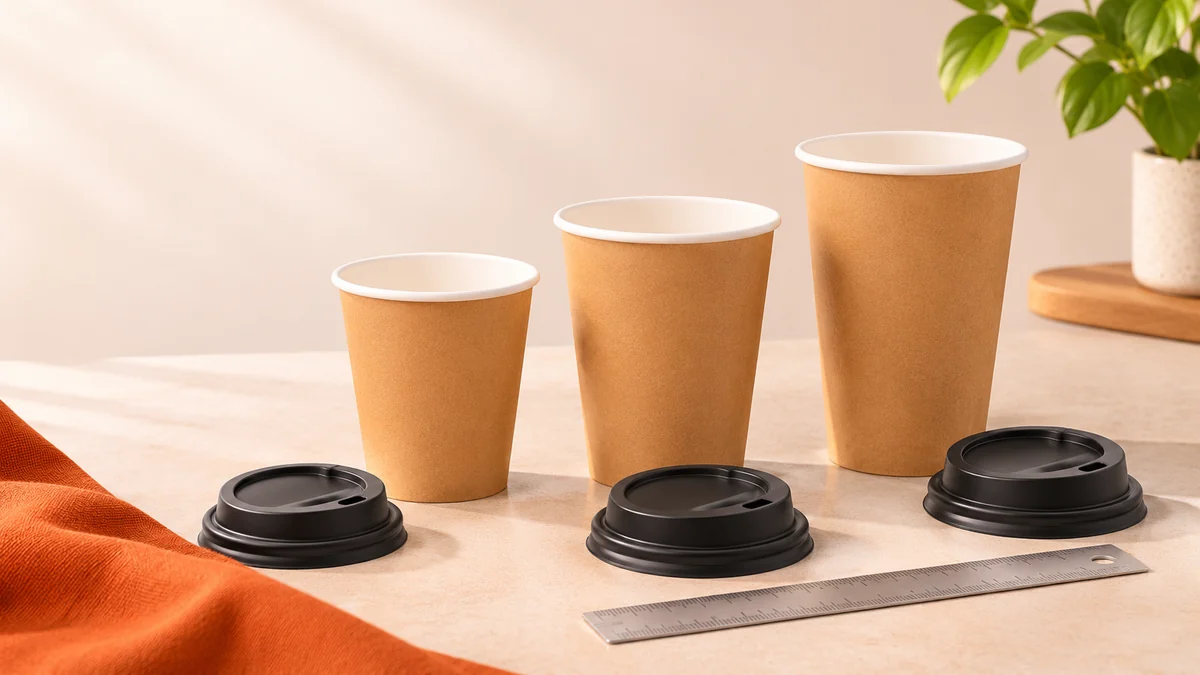
| 8 oz | ≈237 mL | 280 mL | 80 × 91 × 57 mm | Small coffee, cappuccino, tea |
| 12 oz | ≈355 mL | 400 mL | 89 × 110 × 60 mm | Regular coffee, latte, hot chocolate |
| 16 oz | ≈473 mL | 520 mL | 89 × 135 × 60 mm | Large takeaway coffee and tea |
Important: The dimensions and listed capacities are Jorange single-wall white cup reference configurations, not universal industry standards or guaranteed usable drink volumes. They must be confirmed for the exact material and model before purchase. US fl oz values are rounded conversions using the NIST conversion factor.
Notice the two larger reference cups use the same 89 mm stated rim diameter while their heights differ. That can simplify purchasing matching lids for those specific models, provided a physical fit check confirms the selected cup-and-lid combination. It does not mean that every 12 oz and 16 oz cup on the market shares one lid.
Why an “8 oz” Paper Cup May List More Than 237 mL
There are three separate numbers a buyer should keep apart:
- Nominal size: the familiar market label, such as 8 oz or 12 oz. Using US fluid ounces, 8 oz converts to approximately 237 mL.
- Manufacturer’s stated capacity: the value in the product data sheet for a particular cup construction. It may differ from the mathematical conversion of the marketing label.
- Working serving volume: the liquid and foam volume your staff actually put into the cup, leaving appropriate room for the lid and normal handling.
That distinction matters when a café serves a drink described on the menu as 300 mL. A 12 oz paper cup may look like an obvious choice, but the relevant test is whether the actual recipe fits with the preferred headspace, milk foam and lid—not whether 12 × 29.57 gives a number close to 300.
Which Coffee Cup Size Should Your Business Stock?
Small servings
Consider for smaller hot drinks and cafés with compact portions. Check machine clearance, foam headspace and whether your preferred lid series fits.
Regular menu size
A practical candidate for a medium coffee or latte. Test the actual drink build, especially when syrups, milk and foam are part of the recipe.
Large takeaway drinks
Suitable to evaluate for larger menu options. Confirm grip comfort, fill handling, carrier fit and the completed drink’s weight.
If you offer several sizes, start with your current point-of-sale data: what percentage of customers order small, regular and large drinks? A two-size range can sometimes be easier to operate than three sizes, especially if you have limited storage space. If you need a third size, choose it for demonstrated menu demand, not just because the supplier lists it.
For hot takeaway service, the cup construction also matters. A single-wall cup may need a separate sleeve, while double-wall or corrugated styles can improve hand comfort depending on the design. We explain that trade-off separately in our single-wall vs double-wall paper cups comparison.
Cup Rim Diameter Is a Separate Buying Decision
The cup’s nominal ounce size does not tell you exactly which lid will snap on. The lid must engage the actual rolled rim of the selected cup. Diameter, rim profile, material stiffness and lid locking shape affect the result.
Here is a useful example from Jorange’s own range: the listed 8 oz single-wall white reference has an 80 mm rim, but the 8 oz kraft/textured double-wall range also includes an approximately 89 mm rim option. Two cups called “8 oz” therefore may require different lid families. The product code matters more than the size nickname.
A fast cup-and-lid sample check
- Write down the exact cup SKU, lid SKU, material, rim diameter and the supplier’s published tolerance or drawing when available.
- Fit the lid on multiple cups from the sample batch. Check whether it sits evenly and can be applied without excessive force.
- Prepare the intended drink with the usual temperature and fill level. For hot drinks, use safe handling precautions.
- Carry the filled cup as a customer or delivery rider would. Check for lifting, rim seepage and excessive movement. Do not assume any snap-on lid is completely leakproof.
- Keep one approved cup-and-lid sample or a recorded pairing reference for future reorders.
Also check your takeaway cup carriers against the filled cup’s bottom shape and weight. A lid that fits well does not guarantee the cup will sit securely in a carrier.
What to Include in a Wholesale Paper Cup RFQ
A request that says only “Please quote 12 oz printed coffee cups” leaves too much room for misunderstandings. A stronger quotation request should identify the whole serving setup, including the following items:
- Desired sizes, expected quantity per size and intended beverage use
- Actual target serving volume in mL and whether the drink includes foam or ice
- Requested cup construction: single-wall, double-wall, kraft or another available format
- Exact rim diameter, lid type and compatibility requirements
- Logo artwork, color references and any special finishing requests
- Target delivery country, packing format and required documentation
- Sample availability, approval procedure, lead time and repeat-order requirements
A short example you can send to a supplier
RFQ example (illustrative): “We need takeaway hot coffee cups in 8 oz and 12 oz sizes, with matching sip lids. Our regular drink has a target serving volume of approximately 300 mL including milk, before any foam adjustment. Please confirm the stated capacity, rim × height × base dimensions, available wall constructions, printed MOQ per size, carton quantity, sample arrangements and shipping quote to our destination.”
This example is for requesting information, not a confirmed Jorange manufacturing specification.
Three Mistakes to Avoid Before a Bulk Order
- Ordering lids by cup ounces: “12 oz lid” is not a sufficient technical specification. Confirm the exact cup/lid pairing.
- Assuming the label equals usable fill: a 12 oz market name does not automatically mean the cup should be filled to 355 mL under every service condition.
- Approving a cup without a full drink test: inspect the filled cup, lid, sleeve (if used) and carrier together; small sourcing mismatches become much more costly at scale.
Paper Cup Sizes FAQ
Is a 12 oz coffee cup always exactly 355 mL?
No. Twelve US fluid ounces convert to approximately 355 mL, but a supplier may publish a different capacity for a cup marketed as 12 oz. Confirm the exact model’s specifications and test your actual working fill.
Can 12 oz and 16 oz paper cups use the same lid?
They sometimes can within a designed cup family. For example, Jorange’s listed single-wall white reference models share an 89 mm stated rim, but lid compatibility still requires confirmation using the exact cup and lid models.
Should a café buy 8 oz, 12 oz and 16 oz cups at once?
Not necessarily. Start with your menu, measured serving recipes and actual sales mix. A smaller range with correctly matched lids may be easier to manage than stocking every available size.
Does double-wall change the cup’s capacity?
It can change the physical construction, but the effect on capacity depends on the selected mold and specification. Do not assume a single-wall and double-wall cup have identical dimensions just because both are sold as 12 oz.
What sample checks matter before ordering printed cups?
Test the drink fill, rim and lid fit, comfortable handling, print proof, and carrier compatibility. Confirm the final product drawing and packing details with the supplier before approving production.
Need Paper Cups Sized for Your Coffee Menu?
Send Jorange Packaging your target serving volume, preferred cup sizes, lid needs, artwork and estimated order quantities. We can review available reference models and the specifications needed for a quotation.
Request a Paper Cup QuotePrefer a product overview? Explore our paper cup ranges.
Reference notes: The conversion of US fluid ounces to milliliters follows NIST. Jorange-specific reference cup capacities, rim dimensions and standard-cup MOQ are taken from the published Jorange Paper Cups collection, checked in November 2026. These specifications can change; confirm your selected model before ordering.