Material science / temperature-responsive products
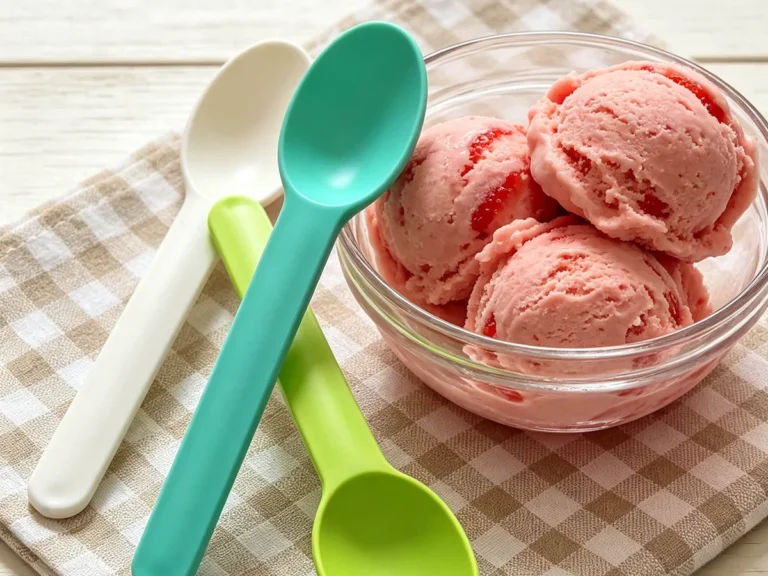
A dessert spoon that changes shade when it touches cold ice cream is memorable. It can make a simple takeaway dessert feel interactive, but its behavior is more interesting than the color itself. Why does the spoon appear blue, pink or purple? Why does one section change while another stays the same? And why might the response look different in two batches or under different lighting?
To understand the effect, it helps to separate three questions: what material forms the spoon, what ingredient creates the temperature-sensitive appearance, and what use conditions trigger a visible change. This guide focuses on the science rather than on a general wholesale shopping checklist.
How Do Color-Changing Spoons Work?
The general phenomenon is called thermochromism: a material changes visible appearance when its temperature changes. Thermochromic systems can be designed to respond at different temperatures, so the color effect is not necessarily limited to heat. A spoon designed for a chilled dessert may be formulated to look different after it cools, while a baby-feeding spoon may be designed to respond when food becomes hot.
Materials company LCR Hallcrest / Liquid Ink explains one common mechanism: microencapsulated leuco-dye systems that switch appearance as a temperature-dependent internal medium changes state. The exact chemistry and activation point depend on the pigment grade.
What happens inside a thermochromic pigment?
In a common reversible leuco-dye system, tiny capsules contain ingredients that interact to form a visible color in one temperature state. As the surrounding material crosses the formulation’s transition range, that interaction changes and the pigment may become lighter or appear colorless. On returning to the original temperature range, the pigment can recover its earlier appearance.
This explanation describes a common pigment family, not every color-changing spoon on the market. Other thermochromic systems exist, and the behavior of a finished spoon should be established from its actual material formulation and sample performance.
Why Do Some Spoons Change Color in Cold Ice Cream?
A cold dessert transfers heat away from the spoon surface. If the resulting temperature crosses the selected pigment’s activation range, the spoon can visibly change color. The exact direction of the change is formulation-dependent: some products become more strongly colored in the cold, while others reveal a different underlying shade.
Specialist supplier Hallcrest describes thermochromic masterbatch for molded plastics and notes that colors can be combined with other pigments to create different effects. This helps explain why a spoon can appear to switch between two colors rather than simply becoming transparent.
Why the handle and bowl can show different colors
Different parts of a spoon may be at different temperatures. The bowl is in direct contact with ice cream, while much of the handle remains exposed to room-temperature air or a person’s hand. A visible gradient may therefore appear across the spoon even if its underlying pigment distribution is uniform.
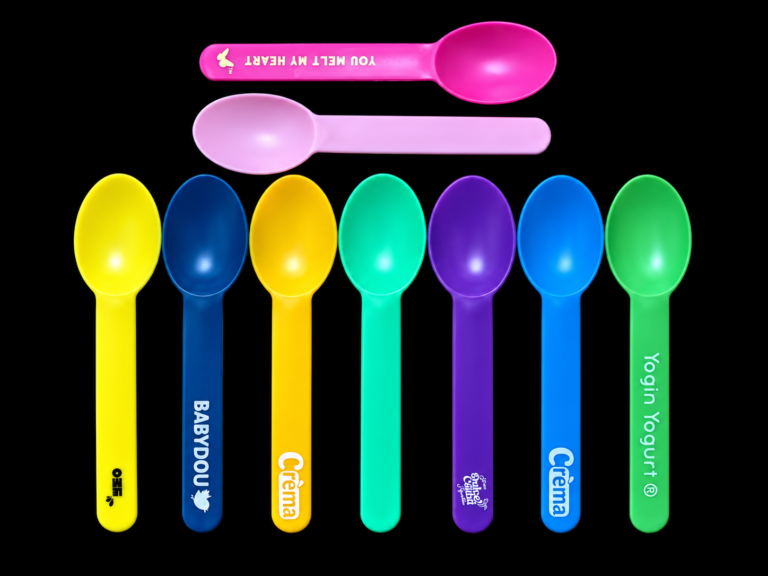
The final appearance can also be influenced by the original plastic color, pigment distribution, translucency and molding thickness. A brightly colored spoon does not by itself prove that the product is thermochromic; only a reproducible temperature-driven color response demonstrates the intended feature.
Does PP Make a Spoon Change Color?
No. PP, or polypropylene, is the base polymer used for many plastic utensils, cups and foodservice items. Ordinary PP does not automatically change color when placed in ice cream. A temperature-responsive appearance generally requires a suitable additive system or specialized construction.
PP can be one possible carrier material for a color-changing formulation, but the formulation must be compatible with the manufacturing process and intended application. Commercial pigments are available as concentrates or masterbatches, and their suitability should be evaluated for the finished product.
| Component | Main role | What it does not prove |
|---|---|---|
| PP base resin | Provides the utensil’s primary shape and physical properties. | Does not automatically create color-changing behavior. |
| Thermochromic pigment or additive | Creates a visible response within a designed temperature range. | Does not, on its own, establish food-contact suitability. |
| Ordinary color pigment | Sets the base or background color. | Does not necessarily respond to temperature. |
| Finished spoon design | Affects contact area, thickness and handling. | Does not make the spoon a precision thermometer. |
What Is the Activation Temperature?
The activation temperature is the range at which a particular thermochromic system begins to change visibly. It is not necessarily a sharp switch at one exact degree. Color transitions often take place over a range, and the apparent threshold can depend on how the product is tested and observed.
One supplier may offer several pigment grades suited to different applications. The correct selection for a spoon depends on its intended temperature exposure and what change customers are expected to see. Without a supplier-provided specification and a finished-spoon test, it is inappropriate to promise that a particular model changes color at a specific temperature.
Is the change reversible?
Many thermochromic formulations are designed for reversible behavior: the appearance changes during warming or cooling, then returns when the temperature moves back. However, “reversible” does not mean unlimited performance under any conditions. Repeated use, sunlight, strong chemicals or unsuitable processing can affect some pigment systems.
A useful demonstration involves observing the same sample at its ordinary room conditions, then after contact with the intended cold dessert, and finally after returning to its initial conditions. This shows the visual effect in context. More rigorous claims about durability or activation range require defined testing methods.
Why Might the Same Spoon Look Different in Different Conditions?
Several ordinary factors can influence the visible outcome:
- Starting temperature: a spoon stored in a cold room may already be partly activated before it touches a dessert.
- Contact and time: brief contact may produce a smaller effect than sustained contact with a cold surface.
- Base color: a translucent or contrasting background can make a pigment shift appear more dramatic.
- Lighting: warm indoor lighting, daylight and phone-camera processing can change how colors look.
- Material thickness: thicker and thinner sections may warm or cool at different rates.
- Pigment formulation: different grades or concentrations may not have the same transition range.
Because all of these factors interact, photographs are useful for showing an expected effect, but a photograph alone cannot establish an exact activation temperature or lifetime. If a product is sold on a specific performance claim, request the relevant specification and evaluate actual finished samples.
Are Color-Changing Spoons Thermometers?
Not generally. A novelty temperature-responsive spoon is best understood as a visual effect unless the manufacturer has designed and validated it for a defined indicating function. Even if the color changes at a nominal threshold, appearance may depend on contact area, material thickness and observation conditions.
For example, a customer should not rely on a dessert spoon’s color to establish a food-safety holding temperature. A calibrated thermometer and suitable food-handling procedure are needed wherever precise temperature control is required.
The University College London Institute of Making’s thermochromic spoon example illustrates how a temperature-sensitive utensil can reveal a contrasting underlying color. That example is a different spoon construction and intended use; it helps explain the phenomenon but is not a test report for commercial ice-cream spoons.
Does Thermochromic Mean Food Safe?
No. Thermochromic behavior describes how the color responds to temperature. Food-contact suitability is a separate question about the specific base resin, additives, manufacturing process and intended use of the finished item. A PP material designation by itself is not evidence that every pigment-containing spoon meets all applicable food-contact requirements.
For a closer look at the documents a buyer should evaluate, read Are Color-Changing Ice Cream Spoons Food Safe?. The purpose of the present article is to explain the visual mechanism, not to certify a particular spoon.
How Can a Dessert Brand Describe the Color Effect Accurately?
The clearest product language describes the observed feature without overstating it. “Changes appearance when cooled” is different from “shows the exact serving temperature.” The first can be demonstrated with a suitable sample; the second would require an independently supported measurement claim.
For product photography and digital marketing, show the spoon before and after a defined cold exposure using consistent lighting where possible. Avoid presenting an edited photo as a guarantee of how every batch will look in every serving environment.
Frequently Asked Questions About Color-Changing Spoons
How do color-changing spoons work without a battery?
Many designs use thermochromic pigments. Their visible appearance responds to temperature through physical or chemical interactions within the pigment system, so an electrical power source is not required.
Does every PP spoon change color?
No. PP is a common plastic resin. Only appropriately formulated products with a suitable temperature-responsive component should be expected to show a thermochromic effect.
Why does the spoon sometimes show two colors at once?
Parts of the spoon may be at different temperatures or may reveal different background pigments. A gradient can appear while the bowl and handle warm or cool at different rates.
Will the spoon change back to its original color?
Some formulations are reversible and are designed to recover their original appearance when the temperature returns. Ask about the actual product grade and test the specific spoon rather than assuming the effect is unlimited.
Can the color tell me the exact temperature of the ice cream?
Not without specific calibration and validation. A novelty spoon’s color change should not be treated as a precision reading or as proof of food-safety temperature.
Explore Ice Cream Spoon Options
Jorange Packaging offers ice cream spoon options for dessert businesses and packaging buyers. To discuss a temperature-responsive design, share your intended application, desired appearance, preferred spoon size and order quantity. Material and performance claims should be confirmed for the selected product.
View Ice Cream Spoons