Greaseproof vs wax paper for burger wrapping: both can look like ordinary takeaway sheets, but they do not manage oil, moisture and heat in exactly the same way. For a restaurant, burger brand or packaging buyer, choosing between them depends on the actual food and serving conditions—not just a label that says “food-grade.”
What Is Greaseproof Paper?
Greaseproof paper is a paper material engineered to slow the movement of oil and fat through the sheet. Its performance may come from a dense, refined fibre structure, a suitable barrier treatment, or a combination of material and manufacturing choices. The term describes an intended property; it does not refer to one universal recipe.
This matters for burgers because wrapping paper may touch warm buns, sauces, meat juices, melted cheese and fried fillings. Regular uncoated paper can quickly develop visible oil marks. A suitable grease-resistant grade may reduce this transfer and help the outer surface stay easier to handle.
However, “greaseproof” is not a promise of zero leakage. Performance varies with the food’s oil content, serving temperature, pressure, folds and contact time. A sheet that performs well for a freshly served sandwich might not behave the same way around a very oily burger carried in a closed delivery bag.
What Is Wax Paper?
Wax paper is paper treated with wax. The treatment helps create a barrier that reduces how readily liquids or oils move through the sheet. Depending on the wax formulation and finish, waxed papers can be useful for certain wrapping, separation and short-contact food applications.
But the wax introduces an important question: How does the treatment behave at the actual food temperature? Wax can soften or melt with heat. Therefore, a generic wax paper product should not be assumed suitable for direct contact with a freshly cooked burger, a hot holding process or an oven merely because it is sold for food packaging.
The USDA food packaging glossary describes wax-treated food papers as specific constructions. Safe use still depends on the finished product and its instructions.
Greaseproof vs Wax Paper: Key Differences for Burger Wrapping
| Question | Greaseproof paper | Wax paper |
|---|---|---|
| What slows grease? | Dense paper fibres and/or a specified grease-resistant treatment. | Wax treatment or coating applied to the paper. |
| Does it resist oil? | Often designed for this purpose; performance depends on the grade and use. | Can resist oil; results vary with wax type, coverage and use. |
| Hot burger suitability | Possible if the exact grade is qualified for the intended time and temperature. | Do not assume suitability; verify the waxed material’s temperature limits. |
| Custom printing | May be possible after checking ink, paper and intended food-contact side. | Depends on wax treatment, ink adhesion and the full specification. |
| Microwave/oven use | Not automatic; follow the actual product’s instructions. | Not automatic; never infer heating suitability from the name. |
| Recyclable/compostable? | Not guaranteed; coating, contamination and local facilities matter. | Not guaranteed; wax construction and local facilities matter. |
Material naming matters: “Greaseproof,” “waxed,” “parchment” and “coated paper” are not interchangeable specifications. Commercial products may combine properties. Request the material construction and intended-use instructions rather than relying on a category name alone.
Which Paper Makes More Sense for Your Takeaway Menu?
For a hot burger served straight from the grill
Begin with a wrapping grade intended for warm, fatty foods. Ask for its permitted temperature and contact time, whether the food-facing side differs from the printed side, and how the grease barrier behaves at folds. A waxed material may have limitations at elevated temperatures. No general material name can replace a specific product qualification.
For delivery orders with longer holding times
Delivery presents more demanding conditions than a quick handoff at the counter. The paper may be compressed, exposed to steam and held against oily ingredients for longer. An outer burger box can help protect the burger’s shape, but it cannot turn an unsuitable inner wrap into a suitable one. Trial the finished wrap and box together.
For tray liners, fries and sandwiches
Some foodservice applications need a flat liner rather than a folded burger wrap. This changes where oil collects and where pressure is applied. One printed sheet may serve several menu items, but check each use separately. A light sandwich and a portion of hot, oily fries may make very different demands on a paper.
For chilled and room-temperature foods
Heat may be less challenging, but moisture, oils and sauces can still matter. A waxed grade could be considered if its specifications match the food type, temperature and contact period. The right choice remains product-specific rather than category-wide.
Four Checks Before Approving a Burger Wrapping Paper Sample
Oil transfer
Wrap your actual menu item. Look for grease spots, translucent patches and oil transferred to hands, trays or outer cartons after the intended holding time.
Steam, moisture and folds
Check whether sauce or condensation weakens the sheet at corners, seams and pressure points. Water resistance and grease resistance are different properties.
Ink and appearance
Check printed samples for rub-off, odour, unwanted surface changes or loss of legibility under the intended conditions.
Wrap handling
Have staff wrap, unwrap and carry food using the sample. Record tearing, excess folds, speed and whether the sheet dimensions suit your portions.
Formal testing may also be useful. For example, TAPPI T 559 describes a grease resistance kit test designed for certain paper treatments. It is not a universal test for every barrier construction, and a laboratory value should not replace a trial with the actual food. Ask the supplier or testing laboratory which method fits your paper structure.
Food-Contact Requirements in the US and Australia
Grease resistance is a performance characteristic. Food-contact suitability is a separate question. A wrapper can perform well against oil yet still require confirmation that its paper, barrier treatment and printing configuration are appropriate for direct contact with a specific food.
In the United States, the FDA explains that food-contact substances may include packaging components, coatings, adhesives and colourants. Applicable requirements depend on what substances are used and how the finished packaging is intended to contact food. See the FDA’s food-contact overview.
In Australia, Food Standards Australia New Zealand (FSANZ) says food businesses must select packaging that is fit for its intended purpose and unlikely to contaminate food. Consider whether it will touch oily food, how hot it will become, and how long it will remain in contact with the product.
What about PFAS in grease-resistant food papers?
PFAS-containing substances were historically used in some grease-proofing agents for paper food packaging. In January 2025, the FDA announced that 35 related food-contact notifications were no longer effective following the abandonment of those uses. This followed a phase-out of PFAS-containing grease-proofers for US food-contact paper packaging. Read the FDA’s 2025 update.
This is why buyers should ask how a selected wrapper achieves its grease resistance. Do not infer that an individual paper is PFAS-free, compliant everywhere, recyclable or compostable merely from the word “greaseproof.” Request relevant information and documentation for the actual finished paper and treatment, including its intended food-contact conditions.
A vague “FDA approved” statement without an identified specification or relevant scope is not a substitute for checking the material and its intended use. The same principle applies when buying for Australian foodservice operations.
Can You Print Your Logo on Greaseproof Burger Paper?
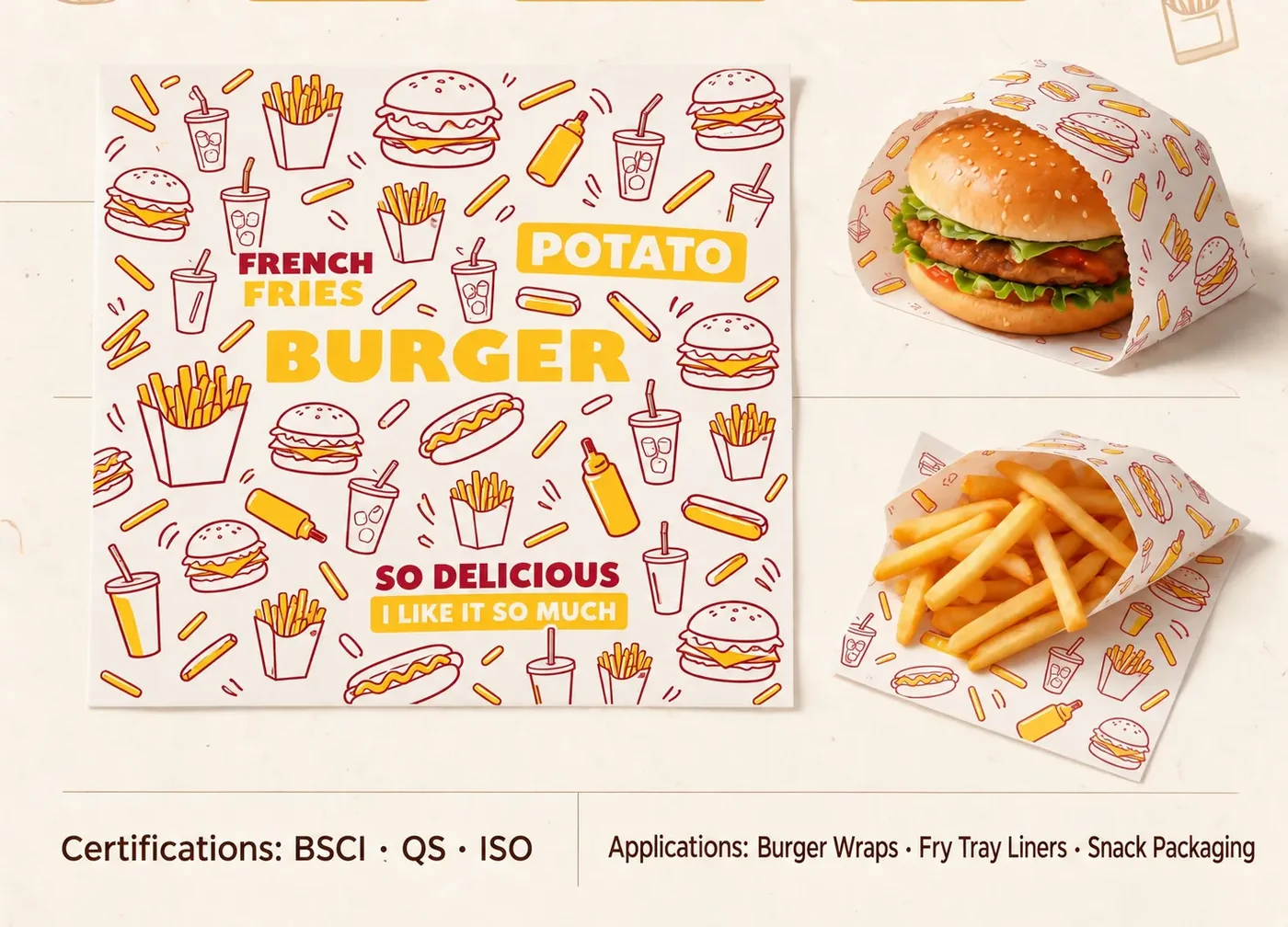
Branded wrapping paper serves two purposes: it helps handle the food and it carries your visual identity. But print placement is important. An ink design intended for the outside of a wrapper may not have been evaluated for direct food contact. Confirm which side of the finished sheet will touch the burger before signing off on the artwork.
Large, solid-colour printed areas may also change how visible oil spots appear. Consider ink adhesion, crease resistance and the dimensions required to wrap your most popular menu item without excessive overlap. These everyday details can affect the customer experience even when the paper meets a basic material specification.
Jorange’s custom burger wrapping paper product page outlines options to discuss, including printed designs, sheet sizes and grease-resistant material requirements. Exact printing method and paper availability depend on the selected specification.
What to Include When Requesting a Burger Wrap Quotation
Rather than asking only for “food-grade burger paper,” describe the actual application. The details below make the supplier’s material review more meaningful:
- Food type: burger, cheeseburger, fried chicken, fries, sandwich or another menu item.
- Oil and sauce: identify ingredients likely to create heavy grease or moisture contact.
- Serving conditions: approximate temperature when wrapped and whether the packaging will be reheated.
- Contact period: quick counter service or a longer takeaway/delivery journey.
- Wrapping style: full wrap, half-wrap, basket liner or tray liner.
- Artwork: sheet dimensions, logo file, number of print colours and which side is intended to contact food.
- Order details: estimated number of sheets, destination country and documents needed for your market.
For the custom burger wrapping paper range described on Jorange’s product page, the minimum order quantity is 10,000 sheets. The final paper grade, coating options, print requirements, documentation, packing and lead time must be checked during quotation.
Frequently Asked Questions
Is greaseproof paper the same as wax paper?
No. Greaseproof paper resists oil through its structure and/or a suitable treatment. Wax paper relies on a wax treatment. Actual properties vary by the specific grade.
Can I wrap a hot burger in wax paper?
Do not assume so. Wax can soften with heat. Check the product’s instructions and approved use conditions before putting it in contact with hot food.
Does greaseproof paper always prevent oil leaks?
No. Oil content, pressure, folds, temperature and contact time all influence the result. Test the chosen sheet with your actual menu item.
Is all greaseproof paper PFAS-free?
The word “greaseproof” cannot establish chemical composition. Ask for relevant information about the exact material, treatment and applicable requirements.
Can printed burger paper touch food?
Only when the finished material and printing configuration are suitable for the intended contact. Confirm the food-facing side and review relevant supplier documentation.
Is greaseproof burger wrapping paper recyclable or compostable?
Not automatically. The selected barrier, contamination level and local collection system matter. Verify environmental claims for the exact finished product and destination.
Planning Custom Burger Wrapping Paper?
Share your food type, sheet size, print design, estimated quantity and destination market. Jorange Packaging can discuss available paper and printing options for your project. Custom burger wrapping paper MOQ: 10,000 sheets.
Request a Custom Quote →