Ice cream spoon materials / food contact
Are Color-Changing Ice Cream Spoons Food Safe? What Buyers Should Check
Quick answer: A color-changing spoon may be suitable for food contact when its complete formulation and intended use meet the applicable rules. The fact that the handle or bowl changes color does not, by itself, prove safety or indicate a problem. Buyers should verify the base polymer, temperature-sensitive additive, any other colorants, the finished product’s use conditions and the supporting compliance documentation.
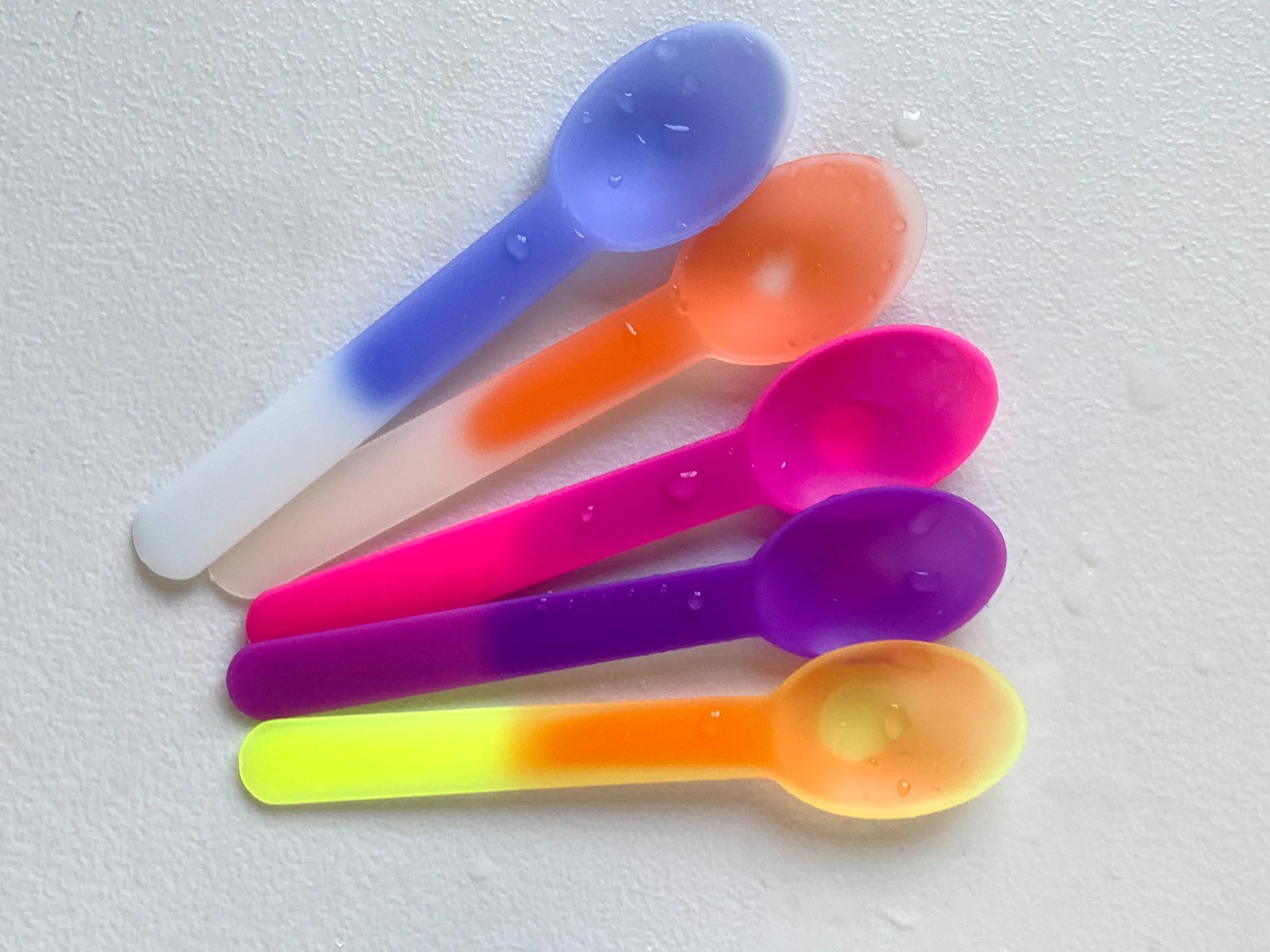
A spoon that shifts color in ice cream can create a memorable dessert experience. For procurement teams, however, a bright design raises a practical question: what makes the spoon change color, and how can a food business establish that it is appropriate for use with frozen yogurt, gelato or other desserts?
This guide focuses on the food-contact questions behind color-changing spoons, rather than on general customization or a demonstration of the effect. It is a framework for reviewing supplier documents, not a claim that every thermochromic spoon is safe or unsafe.
What makes a color-changing plastic spoon change color?
Many temperature-responsive plastics use thermochromic additives. A change in temperature can alter the visible color effect; some formulations return to their original appearance after warming or cooling. The response temperature and color transition depend on the selected pigment system and how it is incorporated into the plastic.
The Institute of Making describes thermochromic spoons as an example of materials that respond visually to temperature. Industry suppliers also describe thermochromic concentrates for polymers including polypropylene (PP). But neither explanation establishes that an unidentified commercial spoon is appropriate for every food-contact application.
Why “made from PP” is not the whole answer
Polypropylene is used in many food-contact products. In the United States, 21 CFR 177.1520 covers specified olefin polymers, including certain PP materials, subject to defined requirements and limitations.
A finished color-changing spoon may contain more than the base resin: pigments or masterbatch, processing aids and other ingredients may be present. The FDA explains that evaluating a food-contact article involves assessing relevant components and their authorized conditions of use, not merely recognizing the name of the main polymer.
That means the right question is not just “Is this PP?” but “Can the manufacturer substantiate the complete finished spoon for its intended food-contact use?”
What documents should a buyer request?
| Item to verify | Why it matters | Useful supplier evidence |
|---|---|---|
| Base material | Identifies the polymer used in the spoon | Product specification and material declaration |
| Thermochromic additive | The color effect may involve ingredients beyond PP | Relevant composition or compliance statement for the selected formulation |
| Intended foods and temperature | Frozen desserts, warm toppings and washing are different uses | Documented contact conditions and restrictions |
| Finished-article compliance | Raw-resin documentation alone may not describe the final colored spoon | Applicable test report, declaration or other substantiation for the actual product |
| Product identity | Reports must correspond to the approved model and color formulation | Model or batch reference and supplier traceability |
For United States sourcing, the FDA food-contact guidance explains the role of component authorizations and use conditions. For European Union markets, the European Commission summarizes the food-contact framework and plastic-specific rules. Buyers should request documentation relevant to the destination market; a logo or generic “FDA approved” phrase on a listing is not enough.
Are the color-changing pigments themselves food-contact approved?
There is no sensible universal yes-or-no answer without knowing the precise chemical formulation, supplier, concentration and use conditions. Thermochromic products are not all identical. The technical supplier LCR Hallcrest describes thermochromic masterbatch systems and recommends independent testing for direct food-contact uses.
This distinction matters when a supplier changes a pigment, shade or resin grade. A test result for one formulation should not automatically be applied to every future color variant.
Does a spoon changing color mean it is a thermometer?
No. A visible color shift does not automatically provide an accurate measurement of food temperature. It may simply be a novelty effect occurring near a designed threshold. Unless the finished product has been separately validated and marketed for a defined temperature-indicating purpose, it should not be used to decide whether food is safe to serve or eat.
Likewise, a spoon that does not change color as quickly as expected is not necessarily unsafe. Color-response performance and chemical food-contact compliance are two different evaluations.
How to check a sample before approving an order
- Confirm the model. Record its actual polymer, spoon length, color combination, intended service temperature and whether it is single-use or intended for repeated use.
- Request the supporting documents. Match the named product, formulation or batch against the documents supplied; ask what the reports cover.
- Observe the effect under intended use conditions. Use a repeatable cold dessert or controlled test environment according to the supplier’s instructions. Record starting conditions, visual response and recovery.
- Check physical usability. Inspect edges, surface finish, handle comfort and suitability for the intended dessert texture. Do not conduct unsafe breakage testing around food being served to customers.
- Verify storage and packaging instructions. Ask whether light exposure, temperature during transportation or other factors can alter the appearance or function over time.
- Approve the exact production version. Keep a sample, final specification and written list of accepted colors or effects; recheck if ingredients or suppliers change.
Food-contact claims buyers should question
“The raw PP resin is food grade, so every finished spoon is compliant.”
The final formulation matters. Base-resin status is important but is not, by itself, proof that additional ingredients and the finished article meet all relevant conditions.
“FDA certified” without a specific supporting document
Ask the seller precisely which requirement applies to the product and request documentation supporting that statement. The FDA authorizes certain substances and uses; wording on a product listing should not replace a clear explanation.
“Safe for any temperature or dishwasher”
Thermal performance, intended reuse and washing conditions must be supported for the actual article. A color-changing novelty spoon should not be assumed to be suitable for hot drinks or repeated dishwashing.
Frequently asked questions
Can a PP color-changing spoon be used with ice cream?
Potentially, yes, if the exact finished spoon is intended and substantiated for that type of food contact. Confirm the formulation, use conditions and documentation with the supplier.
Are thermochromic pigments automatically unsafe?
No. Different pigment systems have different chemical compositions and restrictions. Suitability must be assessed for the specific formulation and intended use.
Does a cold-activated spoon prove the dessert has reached a safe temperature?
No. A novelty color response is not a calibrated food thermometer or a food-safety measurement unless specifically validated for that purpose.
Does a document for the white spoon also cover a colored version?
Not necessarily. Ask whether the evidence includes the actual additives, color formulation and finished product being purchased.
Bottom line
Color-changing spoons can be interesting for dessert brands, but the buyer’s assessment should go beyond appearance. Confirm the base polymer, thermochromic formulation, intended food-contact conditions and finished-product evidence before making a bulk purchasing decision.
Comparing ice cream spoon options?
Browse the Jorange ice cream spoon range. For product inquiries, share the spoon length, intended dessert, target market, color requirements and expected quantity. We can discuss suitable options and what documentation is available for the specific model.
Ask About Spoon Specifications