PRODUCT TESTING / COLOR-CHANGING SPOONS
Color changing PP ice cream spoons should be evaluated using a documented sample test, not a product photo alone. Buyers need to confirm the triggering temperature range, starting and changed colors, response time, reversibility where claimed and batch consistency. The exact color-changing formulation and finished spoon must also be reviewed for food-contact suitability in the destination market.
For ice cream shops and packaging distributors, color changing PP ice cream spoons are a distinctive option only when their appearance, handling and food-contact documentation match the intended application. A good buying decision starts with a test method and a written product specification rather than a promotional color chart.
How does the color-changing effect work?
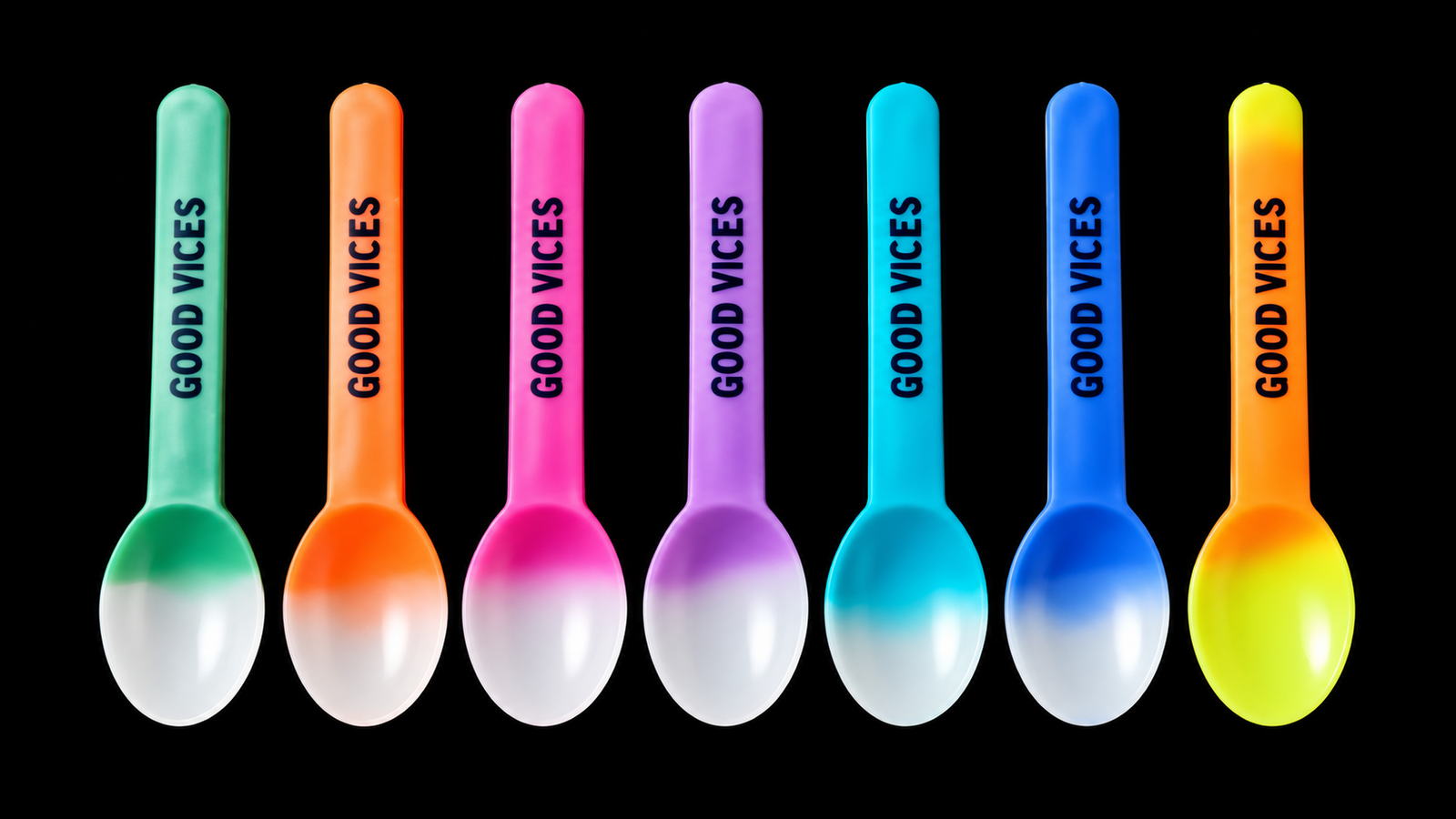
Some temperature-responsive plastics use thermochromic colorants that alter their appearance over a temperature range. The effect depends on the formulation, the background resin color, spoon thickness and environmental conditions. Different products can respond at different temperatures, so a supplier demonstration should not be treated as the specification for every model. The visual effect does not automatically prove that a spoon is suitable for food contact.
Design a repeatable sample test
Before testing, ask the supplier to state the claimed activation conditions. Record the room temperature, spoon starting color, dessert or water temperature, exposure time and the appearance after removal. Repeat with multiple spoons and photograph samples under the same lighting. Do not use excessively hot liquids unless the supplier confirms that temperature is within the intended use and food-contact conditions.
Test 1: color response with a realistic dessert
Use the actual frozen dessert or a safe comparable cold-service setup. Place the spoon in contact with the product for a consistent period and note where the color begins changing. Does the change appear across the handle or only the bowl? Is the effect easy to see against the dessert and cup? Avoid judging color shifts from edited promotional images.
Test 2: recovery and repeat cycles
If the supplier describes the effect as reversible, allow the spoon to return to a defined starting temperature and record whether its original appearance returns. Run several cycles with fresh samples as well as repeated-use samples if repeat performance is an advertised feature. Track uneven transitions, lingering discoloration and variation across pieces. Do not claim a fixed lifetime unless verified by testing.
Test 3: usability and physical finishing
A visually interesting spoon still needs to work. Compare bowl depth and edge finish, handle comfort, stiffness during scooping and any visible molding defects. Test with the same cup depth and dessert texture used in service. Color-changing behavior should not distract from the basic requirements of a food-contact utensil.
Test 4: confirm documentation and claims
Ask for a declaration of material composition and relevant food-contact documentation covering the finished product, including any special colorant. For the EU, the applicable framework includes plastic food-contact legislation such as Regulation (EU) No 10/2011. Requirements in other destination markets differ. Marketing descriptions such as “food safe,” “reusable” or “eco-friendly” should be backed by appropriate product-specific evidence.
Approve colors, packaging and inspection criteria
Specify both the starting color and the expected changed appearance using supplier-approved samples. Agree on the number of spoons per bag or wrapper, carton count, storage conditions and what a rejected color response looks like. Keep a retained approved sample for comparison with bulk production. If multiple shades are ordered, document each combination separately.
Color changing PP ice cream spoons: sample acceptance checklist
Set a measurable acceptance checklist before purchase: identify the starting color, target exposure temperature, agreed observation interval, expected color appearance, test lighting, sample quantity and pass/fail criteria. Ask the supplier to show results on the same spoon model and color combination you intend to order. Keep photographic records of the approved samples so incoming shipments can be compared consistently.
What to include in your RFQ
Provide quantity, intended market, use temperature, target activation behavior, spoon dimensions, initial and changed colors, packaging requirements, sample-testing expectations, shipping address and target delivery window. Ask whether the exact effect has been tested under your stated conditions. A clear RFQ reduces the risk of vague promises and rework.
Bulk shipment checks for PP color-changing ice cream spoons
For larger shipments, confirm the carton label, piece count, approved packaging style and batch identification before dispatch. Request a pre-shipment inspection using samples selected from production cartons, not only showroom samples. Check finish quality, color consistency at rest and response under the agreed cold-service test. Record deviations before accepting the order so any corrective action can be agreed in writing.
Frequently asked questions
Do color-changing spoons always change in ice cream? Not necessarily; performance depends on activation conditions and product formulation.
Are thermochromic spoons automatically compliant for food contact? No. Documentation must cover the finished article and its intended use.
Can the colors be customized? Options vary; confirm feasibility, sample approval and MOQ for each combination.
Request a testable sample
When asking Jorange Packaging about color-changing spoon options, include your dessert serving temperature and intended market. Request a physical sample, documented color behavior and product-specific compliance information before placing a bulk order.
Request a Wholesale Quote →Further reading and references
- European Commission: Food-contact materials legislation
- Faerch: PP material overview
- Explore ice cream spoon options at Jorange Packaging
- Thermochromic colorants: technical background is general; request formulation-specific performance documentation from the actual supplier.